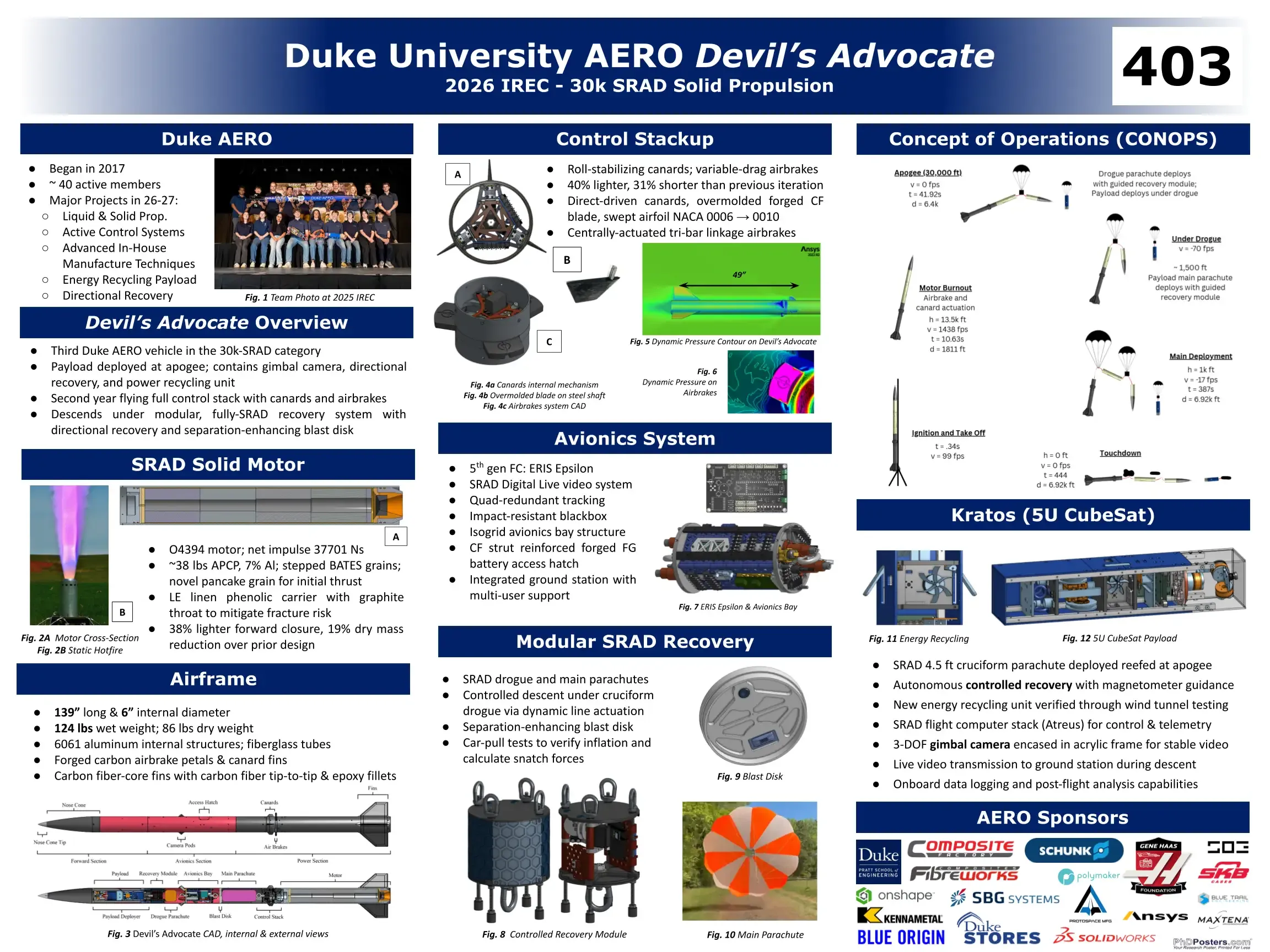
Duke AERO played devil’s advocate at IREC 2026 with another 30,000-foot rocket powered by a solid SRAD motor. Keeping up with our tradition of “we shall build a bigger rocket”, Devil’s Advocate stands 11.5 ft tall, weighs 126 lbs, and is the largest and most advanced rocket our team has built to date.
Powering the rocket is our most powerful motor ever, Ringworm, an O-4384 with 37,700 Ns of total impulse over 8.6s of burn time, and nearly 8 kN of maximum thrust, sending the rocket to Mach 1.7. The motor builds on last year’s design with an optimized closure, a novel four-piece nozzle design, and our very-own Ammonium Perchlorate Composite Propellant blend producing a distinctive Duke-blue flame.
At 30,000 ft above the Texas desert, Devil’s Advocate deploys Kratos, a 5U CubeSat carrying a student-designed gimbal camera, live video feed, and a novel energy-harvesting system that utilizes wind to power a turbine upon descent. Both the rocket and the payload feature guided recovery systems that steers our hand-sewn cruciform parachutes upon descent to reduce wind dispersion.
Controlling the rocket on the way up to target exactly 30,000 ft is the second generation of our Control Stack, featuring the airbrakes and roll-stabilizing canards systems, one of the very few teams to achieve this level of control sophistication. All flight functions are monitored and handled by our fifth-gen flight computer, Eris Epsilon.
The airframe is entirely built in-house with advanced aerospace composite materials and techniques, from the carbon fiber layup nosecone, pre-preg fiberglass avionics body tube, to forged-CF control surfaces and camera pods. Heavy emphasis was placed on achieving exceptional build quality and surface finish to withstand the immense aerodynamic forces at supersonic speeds.
In recognition of the team’s technical excellence, Duke AERO was invited to present at the IREC 2026 podium presentation, showcasing our modular recovery system to judges, sponsors, and other collegiate teams. Our rocket and ground support systems were also recognized and praised by judges and fellow teams for the build quality and creativity.
The road to launch was not without challenges. Fitment issues on the airframe the night before safety review led to some last-minute modifications and a separation test at 4AM. The team then successfully passed all safety reviews and aimed for the first launch window on the first day. However, electrical issues on the launch pad required de-integration for troubleshooting on the pad, and the team were able to re-integrate the rocket in record time for the second launch window.
Despite high winds and dust storms, the rocket experienced a successful launch, reaching to within 8% of our target apogee of 30,000 ft. Telemetry feeds were nominal, our canards system demonstrated functionality for the first time, and the payload was deployed successfully. A parachute malfunction on descent due to high winds led to a hard landing, but the team was able to recover all components of the rocket and payload. The team placed third in the 30,000 ft SRAD propulsion category, a testament to the countless hours of design, testing, and perseverance invested by our members. Every flight teaches us something new, and we’re already applying those lessons to the next generation of rockets, propulsion systems, and recovery technologies as we continue to grow Duke AERO’s technical capabilities.